.png?w=128&h=128&auto=format)
.png?w=256&h=256&auto=format)

.png?w=128&h=128&auto=format)

.png?rect=0,205,1614,1211&w=1600&h=1200&fit=min&auto=format)

Investing in California Burrito

A fresh, made-in-front-of-you meal for the way young India actually eats.

Investing in California Burrito
A fresh, made-in-front-of-you meal for the way young India actually eats.

You don't have to cook fancy or complicated masterpieces, just good food from fresh ingredients.
— Julia Child
Child spent her entire career making the case that good food doesn't require a special occasion. It instead deserves to be on every table for every meal. Fast-casual was eventually built on exactly that premise, and it transformed how the world eats on a workday. India has been the last major market without a serious answer to it. That is until California Burrito entered the scene.
How Urban India Eats Everyday
Imagine a product manager at one of Bengaluru's largest tech parks. Come lunchtime, their choices are narrow: a greasy samosa from the basement, another biryani joint in the food court, and no time this morning to have packed anything better. By 1 p.m., they want something fresh and protein-forward that they can eat at their desk swiftly.
India is not unaccustomed to ordering in. Domino's became the country’s largest QSR chain over the decades because pizza works well in a group format. And for a generation of urban households discovering delivery in the early 2000s, the shared meal was simply the more economical way to explore it. But as India has grown wealthier, that occasion has shifted. The individual meal, once an afterthought in a market built around the shared box, is now a rapidly growing segment and a structural consequence of rising incomes and the changing texture of the urban household.
It is that individual weekday meal, the one the urban professional has been looking for at 1 p.m. on a Tuesday, that California Burrito was built to own.
Enter California Burrito
The format California Burrito chose, Mexican fast-casual, is less foreign to the Indian palate than it first appears, because the base ingredients of Mexican cooking sit closer to the grammar of Indian food than almost any other global cuisine. When a customer picks up a corn tortilla filled with slow-cooked protein and fresh salsa, they are not decoding a foreign menu so much as encountering familiar ingredients in a new arrangement. The category is new to India; the palate, it turns out, is not.
California Burrito today has 100+ outlets across Bengaluru, NCR, Hyderabad, Chennai, and Pune, all of them built on the same assembly-line model. Everything is made to order, in front of the customer, at a ticket size of around INR 250. The stores pay back within 24 months, and sales per square foot per day are best-in-class for the category.

The operating architecture behind those economics is deliberately simple. A single menu template with a choice of protein, grain, vegetable, and sauce produces an almost unlimited range of combinations. This means the customer feels like they are eating something different on Thursday than they did on Monday, even though the kitchen is running the same sequence every time. That sense of personalisation is the engine of the habit, and the data bears it out: 56% of California Burrito customers eat there at least once a week, and 80% at least once a month. On Swiggy, their Menu-to-Order ratio is 25% against a platform average of 15%, meaning that when someone opens the California Burrito listing, they convert at nearly 1.7 times the norm: an outcome of both simplicity of the menu and higher repeat rates.
The delivery side of the business reinforces this in ways that compound over time. Because of low kitchen prep time, California Burrito consistently earns high delivery ratings, which improves its organic ranking on platforms and drives more inbound orders. This creates a self-reinforcing loop, and delivery can account for upto 70% of a store's revenue without requiring additional floor space or front-of-house staff. When a new California Burrito store opens, its delivery base builds faster than its dine-in audience, and that capital efficiency is a large part of what makes the expansion model work.
Behind the model, though, is a founder who decided, at twenty-two years of age, that he was doing this for the long term.
Meet Bert
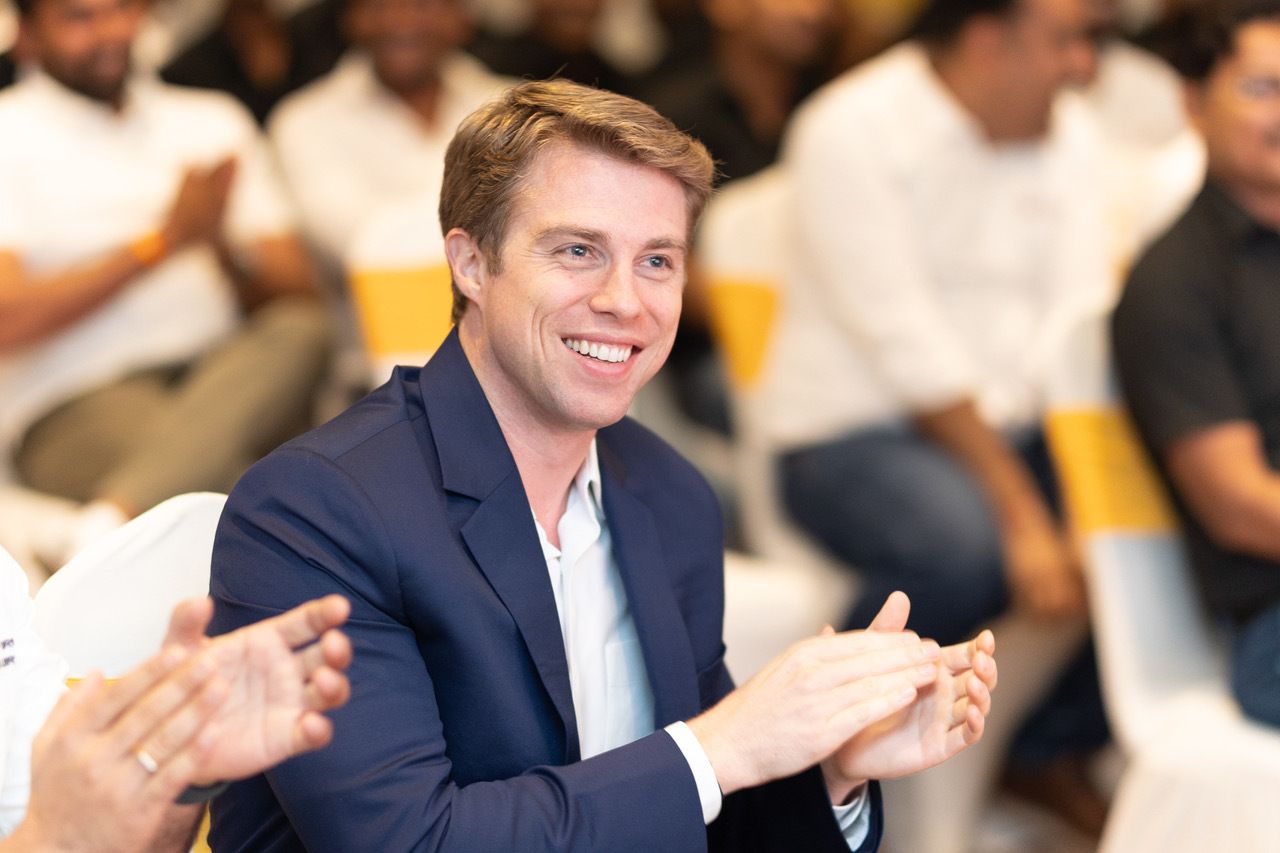
When Bert Mueller was twenty years old, studying abroad in Jaipur on a music and public policy degree, the idea that would consume the next decades of his life first presented itself. A Mexican classmate in his programme cooked her food one evening, and watching everyone’s reaction to it was the moment the idea of a food business fixed itself in Bert and refused to let go. He went back to the US after that semester and spent eight months on the line at Moe's Southwest Grill learning how a kitchen actually worked. He then raised $250,000 from friends and family, moved to Bangalore, and opened the first California Burrito at Embassy Golf Links in October 2012.
.jpeg?w=1200&h=800&auto=format)
What followed over the next decade is the kind of foundational accumulation that separates founders building for five years from those building for twenty. Bert drove to wholesale produce markets to negotiate prices himself, learned Kannada to conduct those negotiations without an intermediary, and contracted farmers in Karnataka and Tamil Nadu to cultivate tomatillos, black beans, roma tomatoes, and Haas avocados for a menu that demanded ingredients most Indian distributors had never been asked to supply. That appetite for going to the source for uncompromising ingredients has only deepened with scale. California Burrito now grows avocados in Coorg and imports beans from Tanzania.
But having the best ingredients is only the first leg of the race. Introducing a new cuisine at scale to consumers in a way that is familiar yet experimental is the second part of the puzzle that Bert cracked beautifully. In 2014, he started by testing a limited time offer "Burritos of India" fusion menu and, after a short run, withdrew it. The lesson he carried back was don't indigenise the product, originate it. He then kept the menu Mexican on purpose, and when a corn tortilla needed explaining to a new customer, he called it a "corn chapati”, wrapping familiarity and novelty in one meal.
Bert's other conviction is one that most QSR operators arrive at too late, if at all: this is a service business, and the person who determines whether the brand lives or dies in any given location is the store manager behind the counter. If each outlet is to be the most compelling option in its immediate catchment, the staff of that outlet is working harder than anyone around them. The energy required to hold that standard across every location doesn't sustain itself, and Bert has addressed it as directly as he has addressed everything else. All store managers gather at the annual CaliB Rally, where the brand's direction is shared as collective property rather than handed down from above. And the top four store managers are rewarded with international travel each year. The head office in California Burrito truly exists in service of the store.
Ajay Kaul, who led Domino's India before becoming one of Bert's early mentors and angel investors, calls him an "American Marwari"; someone who is hands-on and commercially precise, with a quality standard that is genuinely hard to satisfy. Founders who combine that product obsession with real investment in frontline culture and the supply-chain depth to support both are scarce in Indian QSR; founders who built all three from the beginning are rarer still.
The Hard Things
Restaurant businesses fail at a rate that deters most serious investors, and QSR sits at the harder end of that spectrum. The margins in these businesses are unforgiving enough that an untested model rarely survives its first year, and unit economics only begin to compound once operations have been refined down to their smallest moving parts. The brands that endure are almost always built by founders who decided early that they were doing this for the long run, for whom the restaurant is a craft rather than a category play.
Bert opened the first California Burrito in a tech park in October 2012, and the six years that followed were defined by the slow, necessary work of getting the model right. From 2014 to 2020, the business reached ~40 Cr in revenue. The pace looks modest against what came after but reflects the consequential work of refining the menu, the supply chain, and the operational processes that would eventually allow the brand to expand without degrading the product.

This discipline allowed California Burrito to grow as quickly as it could afford to, which is to say carefully, until Swiggy and Zomato became sufficiently mainstream that delivery economics changed the working assumptions for every new outlet. An outlet drawing roughly 70% of its revenue from delivery has a working revenue base from its first month of trading, which gave the brand the confidence to open stores faster and with less capital exposure than its peers. 2021, marked by COVID, was a washout for the category. But California Burrito entered that disruption with the delivery credibility and consumer recognition to accelerate through it, and the four years from 2022 have seen the business compound to ~500 Cr. That’s ten-times-over expansion built on the foundations of the decade that preceded it.
The difficulty of building in this category is the source of its value. Chipotle trades at roughly $40 billion at a 28x P/E; McDonald's at roughly $199 billion at a 24x P/E. Both of which are comparable to the largest consumer packaged-goods businesses in the world. The moat that comes from a daily habit, built one location at a time over decades, is what the market is pricing. The 95% of restaurant businesses that fail pay the entry fee for the 5% that build something durable, and we are betting on California Burrito to be in that 5%.
Market Tailwinds
India recently crossed $2,000 GDP per capita, the threshold at which organised foodservice has historically begun to compound across other comparable markets. But the distance the segment has to travel in India is still considerable.
India has three chained QSR stores per million people, against forty in Brazil and thirteen in China, with per-capita foodservice spend running at roughly a thirteenth of China's level. The chained QSR market has grown at 24% CAGR over the last decade to roughly INR 20,000 Cr, and the top eight cities alone represent more than 300 stores' worth of addressable opportunity for a format like California Burrito's, a market where Domino's already operates approximately 700 stores.
In a segment this large and this early, the defining question is which brand will become the daily meal habit for the growing Indian middle class. That requires two things that are harder to build than they appear:
- a flavour profile the Indian palate reads as its own
- a meal occasion that fits into a weekday rather than a weekend
California Burrito is built for exactly this and the evidence is in the unit economics. California Burrito stores average over ₹1 lakh in daily sales, a figure that reflects a consumer returning by habit rather than by occasion.
Great QSR chains are built through the accumulation of hundreds of thousands of individual meal decisions, made by the same people, returning to the same place, year after year. Bert understood this from the first meal in Jaipur, and he has spent thirteen years building the brand, the supply chain, and the culture that make those decisions possible. What California Burrito is building, at 100+ stores and growing, is exactly what Julia Child was describing: good food from fresh ingredients, for the Indian professional who has been waiting for it at 1 p.m. on a Tuesday. India has not yet produced a category-defining fast-casual chain. We are proud and genuinely delighted to partner with Bert and the team on building the first.
Written by Chirag Chadha, Vaibhav Chowdhury
Related

Harnessing Better Experience And Innovative GTM: Marketplaces Unleashed Part 3
Exploring the last two pillars of our marketplaces framework through case studies
03.08.2023

Vridhi: Reimagining Home Lending For Bharat's Self-Employed
Ram Naresh Sunku, Co-founder, Vridhi Home Finance
11.12.2024

Investing in Atlys
Building the world’s largest digital visa provider
21.09.2023
